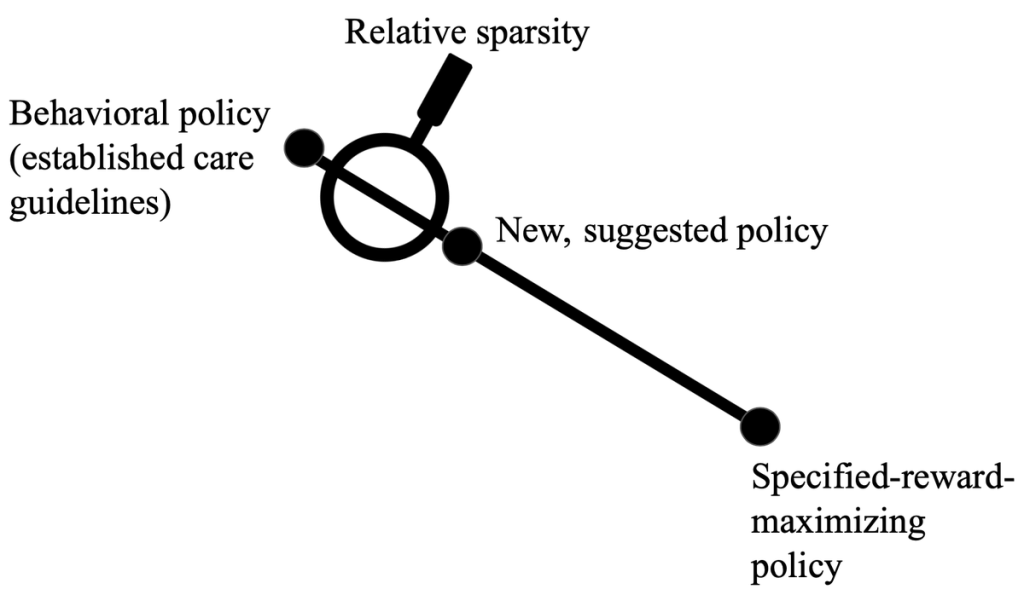
A super interesting research area in statistical medical decision making involves combining the formal decision-making framework (i.e., expected reward/utility) with some form of clinical intuition (or some representation of the currently established care guidelines).
We have a new paper (grateful to Sally and Ashkan for mentorship) on combining the formal framework and the existing clinical guidelines to promote transparency and safety of a new, data-driven treatment policy.
The proposed method provides a new policy that increases (specified) reward but, because of “relative sparsity” with respect to (a model of) the established care guidelines, is easy to justify to stakeholders. It also stays close to established care guidelines, promoting safety.
This work relies on many strong assumptions, especially with respect to the real data analysis, where one needs to assume confounding control and correct specification of the model for the standard of care. A lot of work (eg, relaxing these assumptions) remains to be done.
But, hopefully, this work is a step in the right direction! Using a model to help with high stakes medical decisions can be scary, so having a sense of how the model relates to established care guidelines is useful, which is the underlying “wave” on which this work rides.
As you might have guessed, I think that evidence-based decision models have great promise in healthcare, and I hope that you will check out not just this paper but also this research area (a lot of good work appears in the references)!
A video of my thesis presentation is embedded below.
 Statistics, medicine, and humanity
Leave a reply to Reflections on Relative Sparsity – Statistics, medicine, humanity Cancel reply